“The whole purpose of education is to turn mirrors into windows.”
–Audre Lorde
I begin with this famous quote from the late Audre Lorde, one of America’s most inspiring writers and activists, and a professor who taught at my own university, City University of New York, because it encapsulates higher education’s aspiration for each and every student. You looked in the mirror, saw yourself, knew what you knew and didn’t know, what you could and couldn’t do, and then, suddenly, one day the opacity and fixity of the self you took for granted was opened up and now you see there’s a whole vast vista of possibility ahead. That’s what it means to learn. Whether you are mastering a new skill, tool, concept, method, or insight, you change. The person looking back at you from the mirror is different, the world beyond is transformed. And beside you are classmates who are learning too. Maybe you thought you shared little with them, had nothing in common, but there you are, going through a life-changing experience of growth and possibility, together. “Education,” from Latin educere, to lead out.
I feel so deeply fortunate to have spent my entire career in education. It’s not a career anyone would have predicted for me. I was a rebellious, reluctant, haphazard, and often angry and resentful student. “Dyslexia” wasn’t invented when I was a kid. “Obstinate” was the word teachers used for me. And I was lucky. When I was three, my immigrant grandmother took me to a test given by the Archdiocese of Chicago. In that Sputnik era, when early childhood talent identification was all the rage, I somehow tested as having extraordinary potential in math. That saved me because I am bad at so many things valued in school. I learned to read at an early age but I still find it extremely difficult to read out loud or write by hand. I can understand complex math but can’t add and can’t enter data correctly on a form or calendar or a multiple-choice exam. But because of the fluke of that preschool test, instead of being dismissed as “slow” (the term of the time), teachers said I was too fast. Believe me, there’s a big difference in the blinding reflection that such labels cast upon a child’s self-image. I was in my mid-twenties, already an Assistant Professor at Michigan State University, when my senior colleague and friend Linda Wagner-Martin invited me to go along with her young daughter to a psychologist who was diagnosing a relatively new thing called “learning disabilities.” I’d barely walked through the door before she offered to test me too. I joke it is the only test on which I ever earned a 100%.
Did that background influence my career as a professor dedicated to radical pedagogy and institutional change? Indelibly. In practical terms, I learned early that, if I offered to run difficult programs for my institution, I could request an assistant. I knew that working alongside and in collaboration with someone who had the genius–and it is a form of genius–for all the things I can’t do, that, together, we could accomplish the seemingly impossible. That’s my theory of learning in a nutshell. In fact, it’s the methodology we developed in the organization I cofounded in 2000, HASTAC (“haystack”: Humanities, Arts, Science, and Technology Alliance and Collaboratory), the world’s first and oldest academic social network. We call it “collaboration by difference.” Learning the future together.
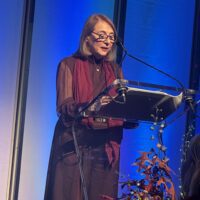
I have no words grand enough to express how honored I am to be a recipient of the Harold. W. McGraw, Jr, Prize in Education. When I look at this year’s recipients, at the astonishingly diverse talents and accomplishments of past honorees since the McGraw Prize’s founding in 1988, I am in awe and humbled. In the words of Harold McGraw: “Our Prize winners are outstanding leaders who have devoted their careers to closing gaps and accelerating educational opportunity to all students.” All is the operative word here. What a sweeping, capacious, encompassing vision!
And one that has never been tested as severely as it is being tested right now. This year, we have seen terrible, systematic assaults on higher education that seem geared to making education meaner, narrower, less valuable to our students and to society. I’m very fortunate to be at CUNY, an institution that has repeatedly reasserted its founding mission to educate “the whole people.” Three precious words to fight for, not to be thrown aside. If “woke” means we are dedicated to a vision of a more just and equitable society, I’m glad no one in this room is sleeping. Or the assault on DEI. In an interview that’s gone viral, the eminent scholar of global medieval literature Geraldine Heng admonishes: “Don’t let people say DEI like it’s a bad word. Make them spell it out. When someone dismisses diversity, equity, and inclusion, ask if they’re choosing homogeneity, inequality, and exclusion.” In accepting this award, I renew my own commitment to ensuring that all students have the opportunity to turn a mirror into a window.
I want to end these brief remarks by thanking the McGraw family for creating and supporting this honor and everyone on the McGraw selection and organizing team at the University of Pennsylvania Graduate School of Education. I thank you not just for myself, personally, but for the light it shines on higher education at a time when far, far too many colleges and universities, facing their own internal financial distress, are acting cowardly, selling out their commitment to the “all,” even “complying in advance” in the famous phrase of the historian of fascism, Timothy Snyder.
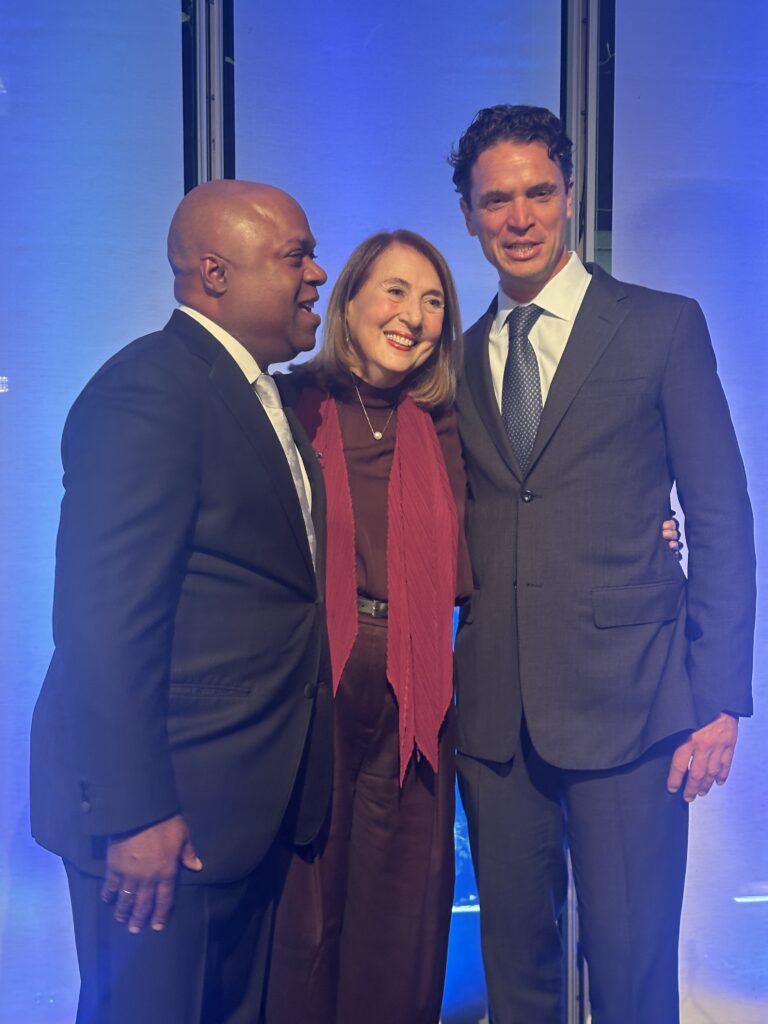
And that’s why I also want to thank the very special people who have joined me here tonight. I have invited a “posse” of courageous, inspiring leaders, nine people who exemplify the qualities of education that I most admire, the community of courage we need to fight for a future of learning and growth for all. First, thanks to my husband, Ken Wissoker, Senior Executive Editor at Duke University Press and Director of Intellectual Publics at the Graduate Center. Ken has made Duke U Press synonymous with daring, bold, visionary scholarship and he risked his career to move here and “telecommute” pre-Covid, when no one knew if that would work. I next thank the three women who are leading the Futures Initiative so boldly into the future—Lauren Melendez, miracle-working director of our CUNY Peer Leaders program; Dr. Adashima Oyo, our visionary, bold, and meticulous Executive Director; and Shelly Eversley, FI’s Faculty Chair, who brings her unequaled energy and dedication to “advancing equity and innovation” higher ed.
Who else is at the table? We need research and scholarship to see beyond the mirror so of course I invited my colleague Herman Bennett, one of America’s most eminent and exciting multilingual, multinational, and multidisciplinary scholars–and a great and generous friend to Ken and me, and to so many others. In that same spirit I invited a friend outside of CUNY, Pulitzer Prize-winning journalist and author, Maria Hinojosa, Founder, President and CEO of Futuro Media Group. At this time when our nation’s free press and commercial media are being sold off to wealthy ideologues, Maria leads us and teaches us all with truth and light. And now the Presidents: Frances Bronet is President of Pratt Institute. My goodness, we need art now more than ever, and it’s hard to imagine a time where the challenges of presiding over an arts school have been greater–or anyone who could lead with more boldness, creativity, and humanity. And at CUNY, Josh Brumberg, President of the Graduate Center. After eleven years–the entire time I’ve been here–of revolving door presidents and provosts, many of whom didn’t “get” what a jewel they’d been entrusted with, Josh leads with wisdom, wit, generosity, and a superpower in “getting stuff done.” Finally, Felo. CUNY Chancellor Félix V. Matos Rodríguez. I’ve been fortunate to work with a number of great leaders, but few with his energy, dedication, caring, humility, and humor. It’s been an honor and a sheer pleasure to be your “Senior Advisor on Transformation.”
Education takes a village. It takes community. It takes heart and strength and love. Collaboration by difference. Turning mirrors into windows for all. We have a very, very long and hard fight ahead if we are going to save higher education at this perilous moment. Let’s do as our New York City Mayor Elect has requested and “Turn the Volume Up!” Now. Thank you!