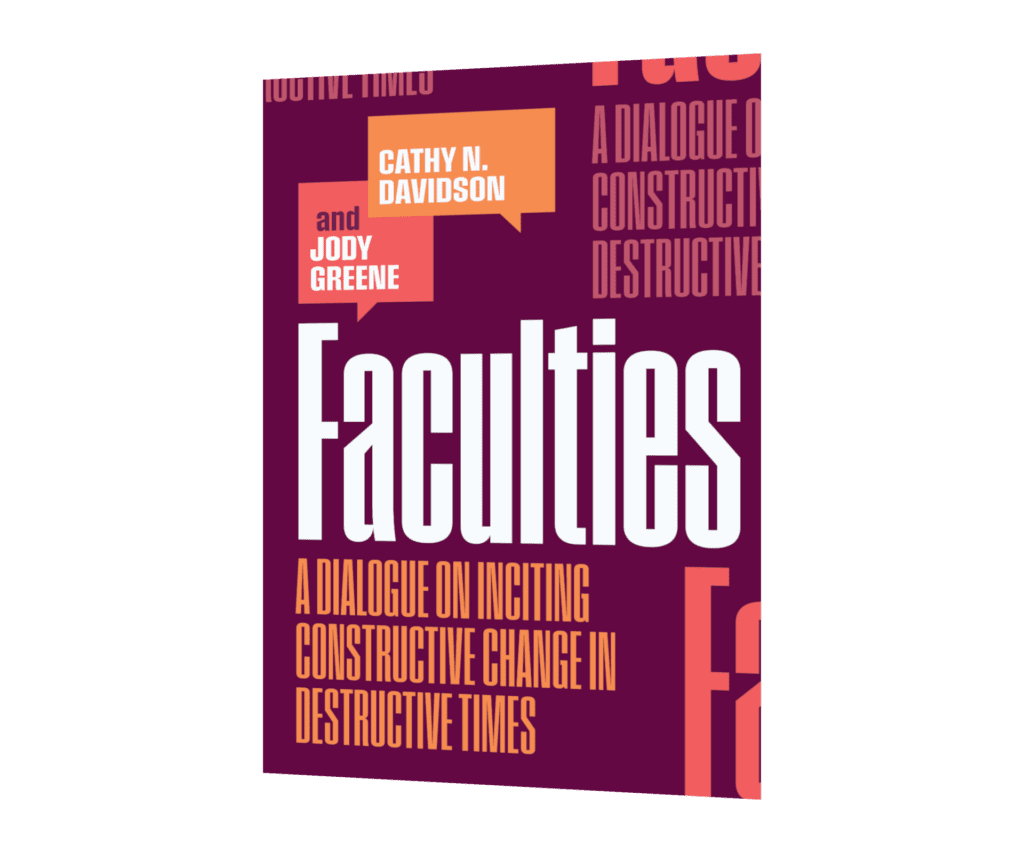
I want to share some nice news: Jody Greene and I have received our irst external appraisal (i.e. “blurb”) for “Faculties: A Dialogue on Inciting Constructive Change in Destructive Times” (forthcoming, Fall 2026, Duke University Press), and it is from someone I admire very much, Wesleyan President Michael Roth. President Roth has been an eloquent spokesperson on behalf of higher education at this time of duress.
“Faculties is for anyone who wants institutional change and hasn’t fallen prey to cynicism or defeatism. The authors know their subject as well as anyone, and they impart their knowledge gracefully. Amidst a crisis in higher education provoked by a mercurial government, the ethos the authors embody arms us for the work to preserve our educational enterprise.” – Michael Roth, President, Wesleyan University
***
This quote came as a total surprise to me. In fact, this morning I sent our editor Liz Ault a link to the latest sharp, incisive piece by indefatigable Michael S. Roth (this one in response to the cynical and wrong-headed piece on Mellon’s funding efforts) and said how honored Jody Greene and I would be if DUP sent him our book and he were to read and write a blurb for our book. VOILA! Liz immediately sent back a link to a new DUP page on our book . . . with this great quote from Michael Roth. It is deeply gratifying. He sees what we are doing and nails it (of course: that’s what he does).
This book has been a labor of love for Jody and me. Thanks to Liz and the three outside readers and the DUP board, we revised and revised, striving for a measured, calm, knowledgeable, instructive book that will help people do the job they came into this profession to do. The book is aimed primarily at faculty members and also faculty occupying various positions such as head of a search or review committee, chair, dean, program director, Senate chair, or other such administrative/faculty positions. We offer useful advice for working together, in solidarity and with purpose, in this undermining and divisive time. Some of the advice is drawn from our own experiences, much from that of others we know, and all is supported by abundant research and references. All this was added on top of an actual dialogue we engaged in (on Zoom) and then edited copiously. So the tone is conversational, with lots of “thinking through” and “back and forth,” with both shared and distinct experiences, agreements and points of push back. We hope to model dialogic exchange and the kind of networking and teamwork that nonprofits, NGOs, and other organizations use to make effective change. All, though, is supported by extensive and serious documentation, references, citations, data, and an extensive list of additional, useful readings compiled by our colleague and research assistant on the project, Will Arguelles..
We found that it is much easier to deliver critique than solutions–but we wanted a book full of useful suggestions, potential solutions. Critique is important too, of course. But once you know what is wrong, how do you work, together, to make it right–or, if not right, at least better. What do you do when you had no say in a decision and no control over it but now must make sense of the shambles? How do you live well–serving your students and your own goals as a faculty member–amid the ruins? How do you keep alive your commitment for academic change of a constructive and productive sort, when there’s destruction all around and the real issues (how to make a truly relevant, deep, meaningful educational experience supported by excellent research) are untouched or, worse, seared or severed by the cutbacks? We compiled so many examples of change that is working–even in these conditions–and we hope that will help those who feel demoralized towards working together towards goals that still count, that are still meaningful.
As writers, that was a challenge since it’s hard to talk about successes amid so many failures, so much harm, without sounding bombastic. But we need examples of success to inspire us. Still, how to recommend a course of action without seeming obtuse or self-satisfied is tricky business. We know because, when we were both in minor administrative roles, we began having weekly conversations at least partly to inspire one another, to offer one another examples that we’d learned from reading the daily higher ed press or that we had heard about from colleagues. These conversations proved so salutary to us that we have worked to compile them in this book, in a readable and accessible way, across fields, with the hope that they might prove useful to others. We turned in our manuscript in early January of 2025 and the destruction since then has been so extreme that we questioned ourselves over and over about whether this book was even relevant any more. Our tough external readers pushed us even more. We kept at it (although several times we almost gave it up.)
This wonderful comment from President Michael Roth is our first external response. Coming from someone we admire very much, this means a lot. Thank you, President Michael Roth!
(Please note: Any royalties that Cathy Davidson makes from the sale of this book will be contributed to a publishing subvention fund at Duke University Press for new authors.)