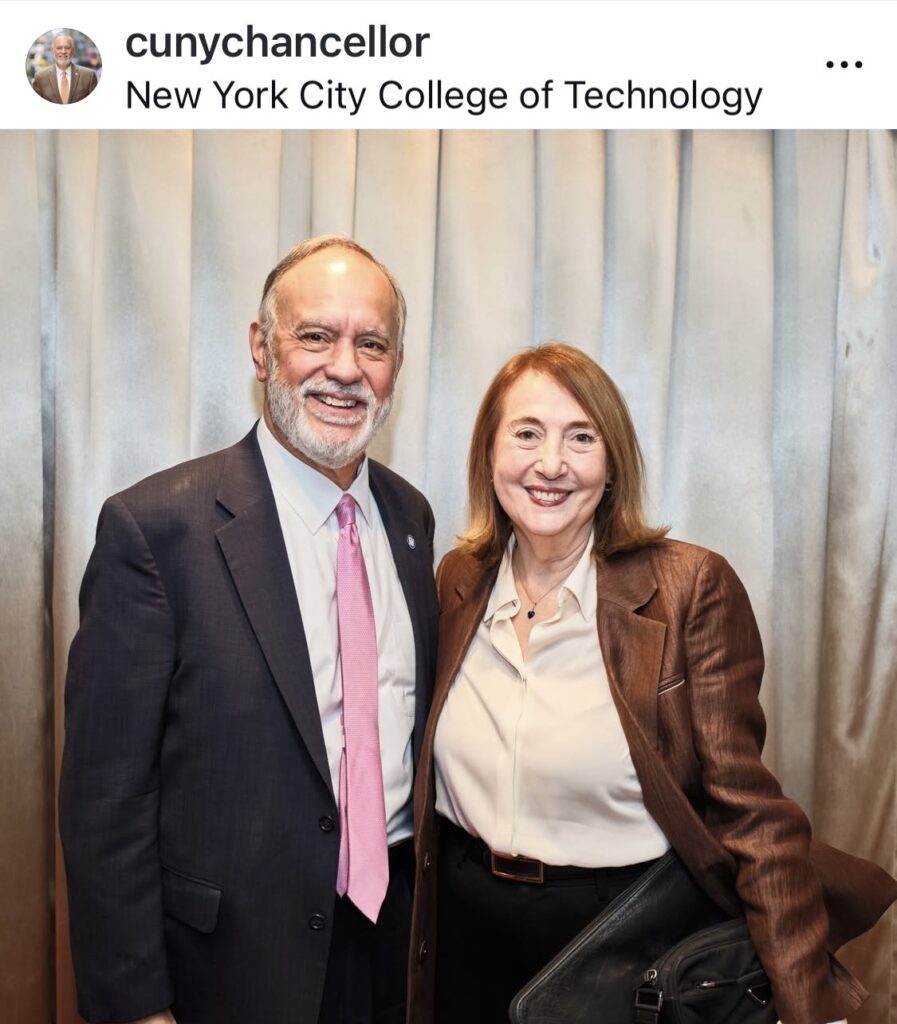

On Thursday, Mary 5, 2026, I keynoted the CUNY Women’s Conference, CUNY Women Lead Loudly: Voice, Vision, and Valor . I was introduced by Chancellor Félix V. Matos Rodríguez, with whom I’d had the honor to work for three years as his Senior Advisor. The conference was organized by co-chairs Dolly Martinez and Shirley de Peña and Confidential Executive Assistant Jackie Cahill. Jackie began her CUNY professional career as a “College Assistant” at the Futures Initiative and, in just four years, has had a spectacular success, including being recognized many times from on stage for all her work organizing this splendid conference.
In my keynote, “Turn the Volume Up!” I offered attendees a “sneak preview” of some of the key advice offered in my forthcoming book, coauthored with Jody Greene, Faculties: A Dialogue on Inciting Constructive Change in Destructive Times. Our wonderful editor, Elizabeth Ault, at Duke University Press tells us it will be published this Fall. So this is a first glimpse.
In my keynote, I talked about how Jody and I began Zooming in the aftermath of the Covid crisis. Jody is the founder of the Teaching and Learning Center at UC Santa Cruz and former Associate Campus Vice Provost there. She and I both held modest institutional roles (meaning, we were not president, provost, or dean) and yet with quite a lot of complex managerial responsibilities and focusing on topics that some find controversial or challenging–active learning and pedagogy, “accountability” in its various forms, equity and innovation, career success for faculty as well as students, shared governance, academic freedom, and other issues that are key to the educational mission but understood quite differently by different people. UCSC is a triple “minority serving institution.” The programs I’m involved with extend across the 26 CUNY campuses–two-year, four-year, professional schools, and graduate schools, with different purposes, audiences, institutional structures, and labor conditions. CUNY is the nation’s largest public, urban university system–and arguably its most underfunded.
Our purpose in our Zoom conversations wasn’t just “chatting” but to consult with one another and use one another as a sounding board when each of us faced a difficult situation and wanted to talk to someone “out of school,” as it were–meaning someone who was not at our own institution and who did not know any of the players. We listened to one another and responded as candidly as we could. What surprised us in the best possible way is that these suggestions helped make the rest of our week far more efficient. So we decided to schedule another Zoom call for the following week, realizing it was a time-saver rather than a time-sink. Neither of us had any inkling that we’d end up zooming for one hour a week for over two years!
We certainly had not planned on turning our sessions into a book. Partly at the urging of friends, partly because, even before January of 2025, higher education was under duress and in absolute crisis in many parts of the country, it felt as if we had some insights to share that might be useful to others. We decided to preserve the dialogue form of our original conversations (carefully edited and supplemented with extensive citations, data, and bibliography for further reading). Dialogue exemplifies process, perspective, and shared differences among institutional equals as a method constitutive of effective collaboration and successful academic leadership.
Our book also acknowledges that very few of us have been trained for the complex leadership roles that inevitably fall to us within the university even at the best of times. Sometimes these roles are official, and we faculty seemingly overnight are changed from “faculty” to that weird and often negatively-valenced creature called “an administrator.” We were in a department yesterday and suddenly, today, we are chairing one, making decisions that have impact on colleagues already feeling bruised and abused. Friends suddenly regard us with suspicion, or even as the enemy. And no one gives us a handbook for running a department well or for weathering the withering looks, suspicion, and sometimes even outright distrust of erstwhile colleagues.
Or we have even less of an official role than chair but still need to organize our colleagues and orchestrate a successful process. Perhaps we’ve agreed to chair a taskforce, or lead a search committees, preserve and champion a diversity initiative against all odds, work to salvage humanities programs enduring extreme cutbacks, maintain the vital work of labs that have been overnight deprived of federal grand money, or are trying to decide with a committee of faculty and administrative staff and IT experts how and when to incorporate AI wisely into the curriculum. Where do we begin? How does one make firm administrative decisions without formal, structural institutional tools or management experience–and with traditions of “academic freedom” and “faculty governance” which encourage outright criticism and dissent . . . but with the ultimate responsibility for decision making falling to you as chair? How do you “represent” a voluntary body of colleagues who may not agree with one another?
There are hundreds, maybe thousands, of articles and books on academic and institutional governance but very little of it is by faculty, for faculty, and with specific attention to making things work within the complex conditions of academic life. It is relatively rare for a faculty member to go through a whole career without at some point leading something or assuming some kind of institutional leadership role, if not chair or dean, then maybe a director of a graduate or undergraduate program or a vice dean for student support or equity, or a vice provost or divisional dean. The possibilities are everywhere and with shockingly little guidance. There is often even little awareness of what the job entails until one steps into it. Suddenly one goes from being a relatively independent operator, for example, to being a “supervisor” and having a staff of people whom one has to lead, organize, and evaluate. Earning a PhD rarely even trains us to teach let alone supervise professional and administrative staff and convene committees of faculty with specific responsibilities and goals to achieve.
Managing and leading in higher education comes with its own quite specific set of challenges, ones that most of the standard business and management books do not begin to address. Business writers implicitly assume a hierarchical structure of governance where supervisors tell you what to do and have the power to fire you if you don’t do it to their liking. By contrast, much of our institutional work in higher education happens within and by committees–and often committees on which faculty members and educational professional staff serve voluntarily and without the clear authority lines of supervisor and the supervised.
The kind of administrative and leadership work we do in higher ed is closer to the far more fluid and incomparably more challenging work of non-profit organizations, NGOs, and community organizers who depend upon voluntary contribution for success. Trust is far more important in these kinds of organizations than hierarchy. Structure is often not a “given”–not built into a hierarchical power relationship–but something that in and of itself requires cultivation and attention. Many of the tactics for voluntary groups resemble active learning or radical pedagogy methods in the classroom and for a similar reason: they offer a structure and scaffolding for collaborative, collective, constructive, mission-driven activity.
To that end, Jody and I decided to engage in a series of conversations in which we discussed these topics in the language of faculty (not business), with the assumptions of faculty, but with the end of helping anyone in institutional leadership roles to lead more effectively. We gleaned some insights on collaborative, participatory leadership from literally hundreds of articles and books written by educators and activists. We also relate many real-world successes by various academic colleagues. Despite all the terrible news that sends shock waves through academe on a daily basis, there’s also bold, fierce, important and inspiring work being done on the ground, work we can all learn from.
To give you a sense of the kinds of topics we address in the book as well as the kinds of management issues on which we focus, I’m going to post here the “Ten Moves to Jumpstart Your Revolution” with which we end our book. Over the coming months, I’ll blog about each of these topics.
“Ten Moves to Jumpstart Your Revolution”*
Adapted from Cathy N. Davidson and Jody Greene, Faculties: A Dialogue on Inciting Constructive Change in Destructive Times (Forthcoming, Duke University Press, Fall 2026).
1: Use “Inventory Methods” to Maximize Participation and Avoid “Group Think” (Here’s a blog on those methods: https://cathydavidson.com/blog/pedagogies-of-dissent/)
2: Include Students Whenever Possible
3: Convene and consult a Coalition of the Willing as a Trial Run
4: Collectively Create Guiding Principles, Community Rules, or a Group Constitution (Christina Katopodis and I talk about class constitutions at length in The New College Classroom–they work for convening meetings as well).
5: Share Leadership Roles and Create Collaborative Agendas
6: Learn About Your Institution—and About Your Institution’s Institutions
7: Rely Upon “Collaboration By Difference” and “Multipartiality” (Here’s a Harvard Business Review video on “Collaboration by Difference”: https://hbr.org/2012/05/collaboration-by-difference)
8: Learn from Your Detractors But Don’t Let Them Stop You
9: Don’t Give Up If You Fail To Achieve Optimal Institutional Success Right Away (Academe is full of second chances and repurposing)
10. It’s Your Turn Now. Go for it!
The whole point of gathering these suggestions from others who have used them successfully is to offer them as springboards for your own ideas. Use what works for you, ignore what doesn’t but, by all means, share whatever works best. It’s a destructive time. We can all learn from everybody learning!
*Please note: any royalties that Cathy Davidson receives from the sale of this book go into a publishing subvention fund at Duke University Press for first-time authors.