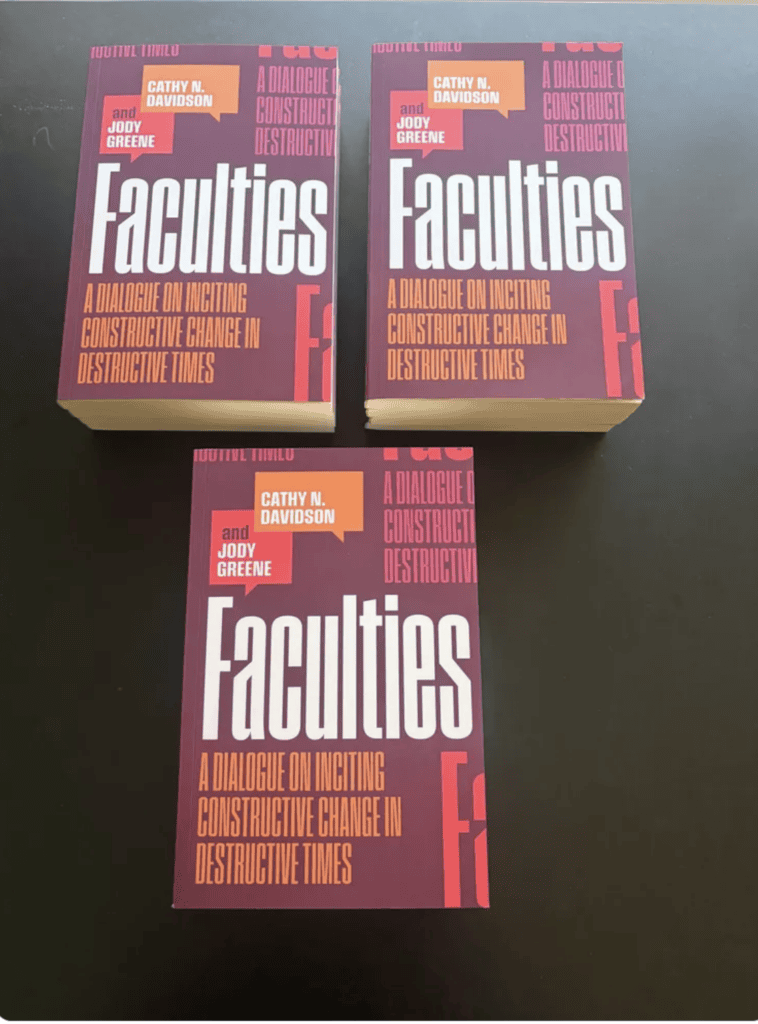
Is there any happier day in the life of an author than when the pre-publication Author Copies arrive? (Oh, okay, maybe if you win a Pulitzer . . . but that doesn’t happen until after the books have been published). Faculties: A Dialogue on Inciting Constructive Change in Destructive Times has arrived… and it’s really, really pretty. (Thank you, brilliant Duke University Press designers.)
One of our early reviewers calls Faculties a “love letter to higher ed.” I like that. Jody and I have watched with horror as university after university has been censored in ways so extensive and destructive that they would make Senator Joe McCarthy blush with shame–or envy. Book bannings. Required syllabi and required readings (Virginia Woolf doesn’t even make the literature list at the University of Texas. Virginia F’in Woolf!). Whole departments destroyed, disbanded, and even forbidden. It’s the opposite of “education.” It’s indoctrination.
We need to organize. Now. We need to organize across institutions and we need to find allies wherever they may be–faculty, administrators, staff, students, community, alums.
Faculties explains structures and offers models, examples, and actual “pro tips” and “how to’s” for organizing meetings, gatherings, building coalitions, all that–so that we can work effectively together among ourselves. We gathered information and insights from other higher ed leaders, from community organizers, from nonprofits, from voluntary organizations (including humanitarian rescue organizations), and from NGOs.
If you are at one of the universities devastated by the right wing, these tactics can help you organize public and institutional collective, strong, powerful coalitions to protest. Where protest is impossible, you can use these tactics to find ways to be creative, imaginative, responsible teachers even within limiting and limited rules. (NB: Our powerful and persuasive voices are more important now than ever, esp in institutions trying to brainwash the next generation).
AND… if you are lucky enough to be at an institution that has not been censored and devastated by ideologically narrow forces (the same ones banning over 350 words from federal research funding, including words like “woman,” “race,” “climate change,” “social justice,” etc), if you are still operating with intellectual and academic freedom: then this book offers tactics for helping you to do the long- overdue institutional reform of pedagogical methods, assessment methods, introductory foundational courses, capstone courses, classroom to career courses, and on and on. We need to be working together towards all the educational transformation that we desperately needed for the last several decades and that GenAI makes imperative. If we, as faculty, don’t initiate and lead change, it will be imposed upon us.
There’s plenty of work for us to do. We hope the tips and tricks and examples and how-to’s and even the “self help” advice we offer will get you started. A brilliant doctoral student Will Arguelles also put together an incredibly useful list of additional resources… and there’s bibliography galore.
ORGANIZE! We can do this. We hope Faculties: A Dialogue On Inciting Constructive Change in Destructive Times will be exactly the catalyst you are looking for. And, by all means, please let us know what you are doing and how so we can pass it on to others. We all learn from everybody learning.
[NB #1: Here’s a 30% discount code: E26FCLTS if you buy at dukeupress.edu/faculties]
[NB#2: Royalties are donated to a fund for first-time authors.]
Contents
Prologue
Chapter One: Why Are We Having This Conversation Now?
Chapter Two: What’s Working in Higher Ed Today?
Chapter Three: Who Inspires Us?
Chapter Four: Meeting the External Challenges
Chapter Five: Meeting the Internal Challenges
Chapter Six: Academic Freedom and Accountability.
Chapter Seven: Shared Governance and Coalition Building
Chapter Eight: Ten Moves To Jumpstart Your Revolution
Notes
Acknowledgments
Bibliography: Useful Books and Articles That Prepare Us To Incite Constructive Change Compiled by William Edward Arguelles
Epigraphs
When we only name the problem, when we state complaint without a constructive focus or
resolution, we take hope away. In this way critique can become merely an expression of profound cynicism, which then works to sustain dominator culture.
—bell hooks, Teaching Community
The point . . . is to make solidarity more doable. And in order to do that I’m trying to strip away
the idea of heroism, perfectionism and pure motive, because I feel that those things are
unachievable and they keep people from trying to participate in solidarity.
–Sarah Schulman, The Fantasy and Necessity of Solidarity
What matters most is how well you walk through the fire.
–Charles Bukowski