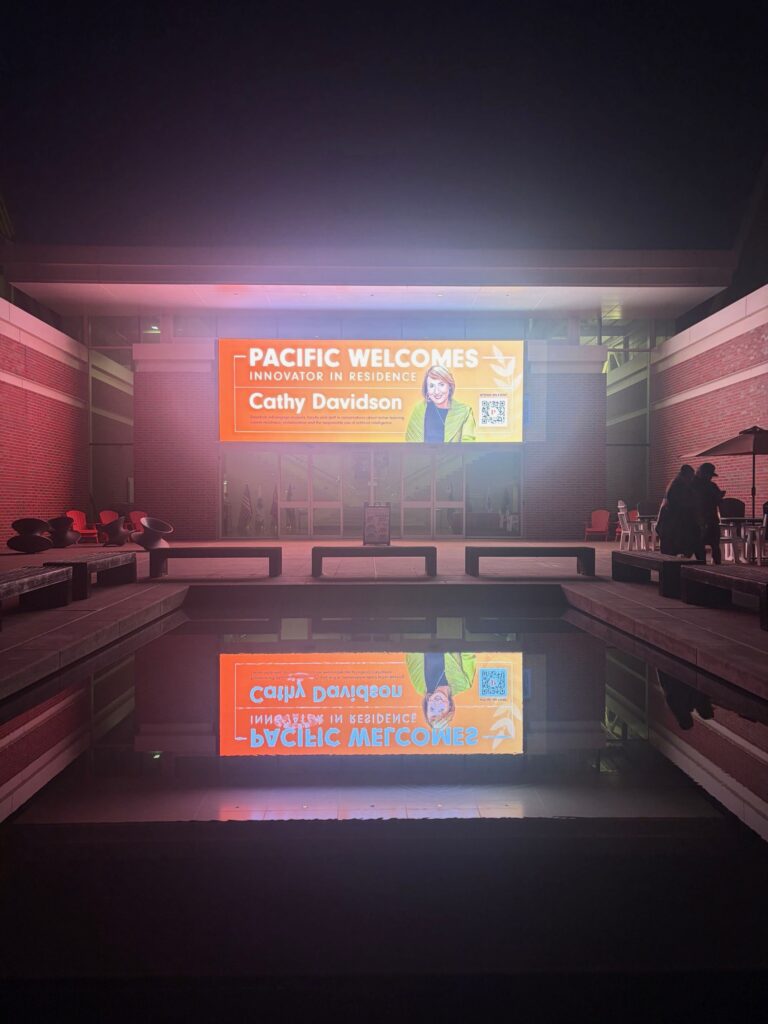
I’m just beginning my second week as “Innovator in Residence” at the truly remarkable and outstanding University of the Pacific in Stockton, CA, in northern California. It’s my second visit here and I’m more impressed every single day. It has the unique distinction of being the oldest university in California–175 years old. It’s a beautiful campus (if you’ve seen the TV comedy-drama Rooster with Steve Carell, it’s set on the Pacific campus and, in fact, they were filming during my visit). It’s a university of just under 7000 students, divided almost equally between undergrads and post-graduates, with several professional schools, and they are beginning to create a next-generation medical school. For all that “big university” advantage and apparatus, Pacific has the feel of a small, cozy, caring liberal arts college. They are through-and-through student-centered–with both abundant student resources and a culture that puts students first.
It’s my kind of place. They are working on making their already distinctive “First-Year Experience” up to the challenges of this historical moment. They’ve already revamped the first-year experiences at the School of Engineering and Computer Science with astonishing results–including superb retention/graduation figures. Now, they are working on the general liberal arts curriculum. That’s one reason I’m here, to help, under the leadership of Prof Jeff Hole, to think through how an already amenable and student-centered structure can become (I truly believe) a national leader in thinking through what students need today to be successful tomorrow.
…
Last night I had the honor and privilege of being on the agenda for the weekly meeting of the Associated Students of the University of the Pacific (ASUOP), a truly excellent group of students who take their role at the University seriously and responsibly. I have been at relatively few faculty senate meetings run as effectively as this gathering. One unique feature: every member reported out on what “needs” they had identified from their constituencies since the previous meeting. I had never seen anything like this before in all my visits to universities and asked how this worked and it turns out the “Senators” take seriously their “representational” role. They are charged with doing all they can to find out, report on, address, and maybe even fulfill the needs of the group they were elected by and represent. Representative democracy in action! It is a big responsibility. The mission of ASUOP: “to empower, advocate for, and engage Pacific students with intentionality, beginning at the margins, by centering diversity, equity, and inclusion.” After 90 minutes with ASUOP, I was wishing I had a job to offer each of them. Now! They are an incredibly impressive group of mature, smart, caring, sane individuals who happen to still be students.
We had a wonderful, free-flowing discussion of many aspects of student life, including thinking about the university of the future, valuing what works in higher ed and working to reform what is antiquated and needs changing, how to take the most advantage of extracurricular activities, and trying to learn and prepare for one’s future in an AI world.
It’s this last issue that ended up being uppermost in the minds of many of the students. Through verbal participation in the conversation and through facial expressions, gesture, and body language, I saw that most if not all of them concurred with a student who, passionately, said (this is a paraphrase): “We do not want to cheat–but faculty make it so easy to cheat that we’re at a disadvantage if we don’t cheat.”
I pushed on this. “We do not want to cheat.” In all the social media faculty forums on AI and cheating that I’ve been part of, I’ve not yet come across this particular perspective articulated so powerfully. These students told me how, often, they see peers with their phones out, feeding exam questions (in fields from accounting to political science) into ChatGPT or some other GenAI program and then just copying out the answers while the professor sets at the front of the room staring into their laptop or cell phone. In competitive fields, for students who are on scholarships and need to keep up a grade point average or who cannot afford (or are not allowed) to drop a class, and in classes where grading is on a bell curve, one student’s cheating unfairly disadvantages all the students who worked and studied hard and who are not cheating and who do not want to cheat.“
Take that in, Dear Professors! I hear you complaining about cheating in exams. I sympathize. And now I hear students complaining that profs don’t back up their complaints with constructive actions and oversight.
This discussion felt real to me. Coupled with inattention to monitoring the exam itself, students also spoke candidly about profs who put a lot of weight on exams and grades but who may be less than attentive when it comes to preparing students for those exams–with study guides, homework reviews, clarity about what will or won’t be on the final.
Students (and, remember, these are brilliant, responsible, caring students) who want to learn and who want to succeed at college deserve better. They deserve better than so many grumpy pundits and profs who complain about “this younger generation”: we’ve all read and heard these complaints. This generation can’t read. This generation can’t do basic math. This generation only cares about social media. This generation was harmed forever by Covid and missing two crucial years of education. This generation… this generation… this generation: Stop it, please!
As is often noted, there is no generation that has not complained about the shortcomings of the younger generation. The ancient Mesopotamian ruler Naram-Sin (circa 2200 BCE), the Greek poet Hesiod, and both Aristotle and Horace all complained that “youth today” were ignorant and lacked discipline and self-control.
What about the elders? What about the faculty? What can the “younger generation” tell the older? When I asked the ASUOP Senators what they would recommend, they offered recommendations for their profs, on both ends of the learning/assessment/cheating problems:
–Better preparation leading into graded assignments (research and exams)
–Clarity about expectations
—Clear rules, guidelines, and penalties for cheating by using AI (or any other source, for that matter) when explicitly forbidden from doing so
—More attention/monitoring during exams, paying more attention to what is actually going on in the exam room
–More proctors and teach assistants to circulate through the room and to watch more carefully during exams
—Alternative ways of assessing learning, ways of measuring learning that cannot be accomplished by feeding the question into ChatGPT and spitting out an answer. (That one, I have to admit, is my own gripe, given how rapidly we forget when our goal isn’t real learning and mastery but knowing enough to ace the test. There is extensive research on the inefficacy of test-based assessment for actual learning. The general consensus is that we lose up to about 70% of data/information within twenty-four hours of an exam, 90% within a week or so—unless learning is reinforced through experiential, project-based, or other kinds of hands’ on application of the learning. NB: Experiments on testing and memory date back at least to Hermann Ebbinghaus’s research in the 1880s!)
***
Okay, Fellow Profs! Time to put away your cell phones and other devices! These very fine students are laying down the gauntlet. It’s our turn to pick it up, to fashion reasonable guidelines and safeguards in this AI world where cheating (as we presently define it in the West–this is not a universal value nor a timeless one) hurts our best students.
I know the University of the Pacific has a whole project on AI and learning–and, in fact, on Thursday, I’ll be in a public discussion with Pacific alum Drew Henry on exactly this topic.
In the meantime, at the very least, we faculty owe it to our students to help them not cheat. The best students know that cheating means they are not learning–and they know that, when their classmates are allowed to cheat without getting caught, without penalty–it makes a mockery of the whole concept of “assessment” and undermines learning at every level.
There is much for all of us to learn in this age of AI. Helping our students not cheat is a start.